


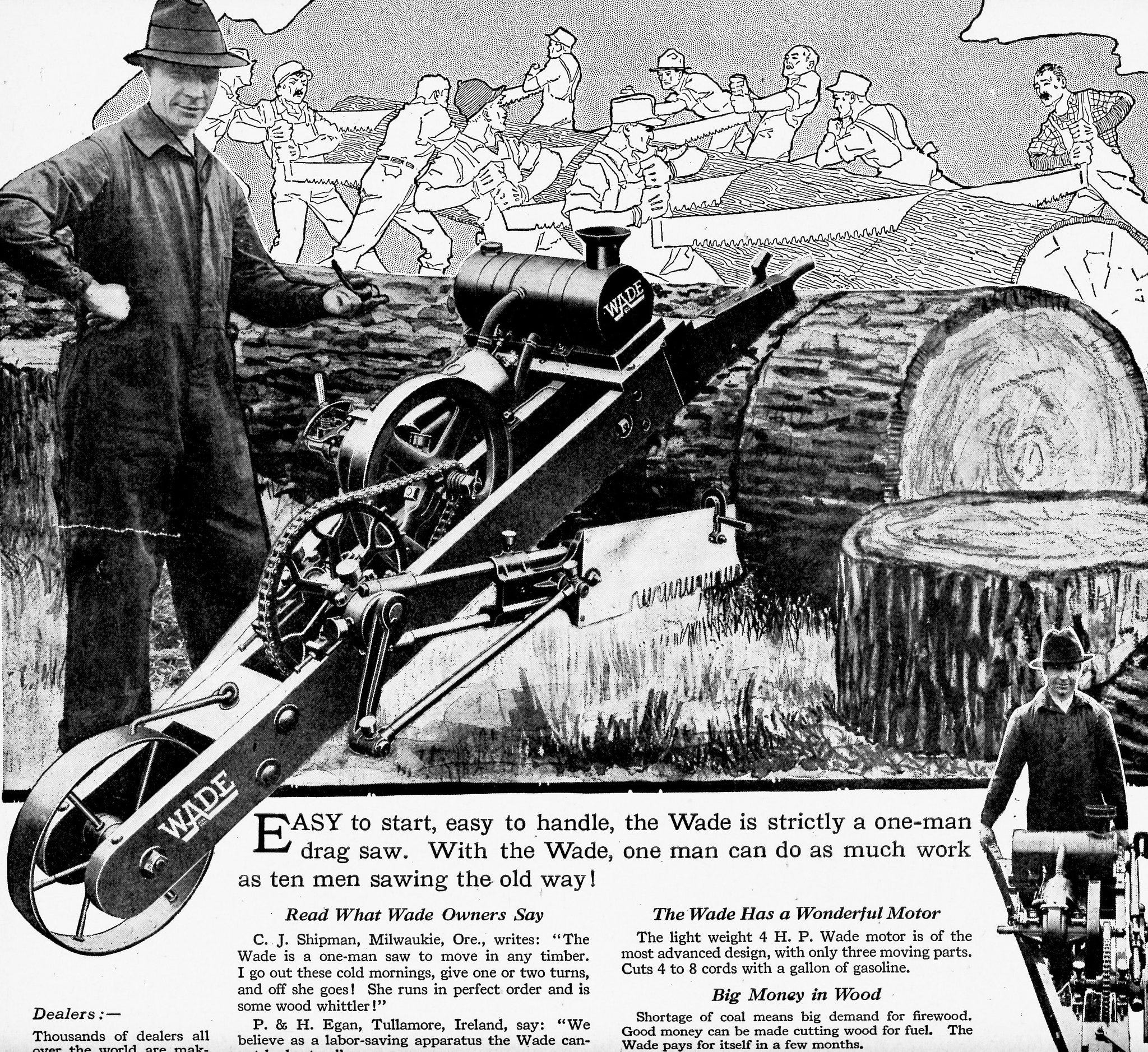
Photo credit: Country Gentleman, 1920
I’ve been saying for awhile that AI is a useful tool but that it’s no replacement for thinking things through yourself, which is what the process of writing helps you do.
The notion that AI could just write things for you is based on a misunderstanding about how writing works. It seems to presume that you have thoughts in your brain, and the goal is to get them on the page as quickly as possible, and that how you describe these thoughts in language is just a negligible and tedious issue of word choice.
That’s wrong, because the very word choices and sentence structure are what create meaning. You can only understand and shape the meaning of what you’re writing by getting down in the thick of it, wrestling with words and phrases and all their connotations and associations.
If you delegate that to a machine, you might be generating content, but it’s not what I would call writing, because a) you haven’t thought through the implications of all the language, b) you’re missing out on the fundamental value and pleasure of writing, which is using your brain to filter ideas through language, and language through ideas, in dialog with an audience (real or imaginary).
I would add, also, that c) the content AI produces is probably extremely generic, and d) it’s likely to contain errors.
There are ways to address this, but in my experience, it’s far easier to just write a first draft yourself. You can’t just 10x yourself as a writer with AI.
Lowered expectations
Various writers have been making similar kinds of statements recently, indicating that people’s expectations of AI have exceeded what it’s actually capable of:
Naval Ravikant said recently that AI is not really having an effect on how he runs his new company, Impossible. Yes, his team uses AI tools, but it’s not changing the way the company fundamentally works.
John Herrman spent some time with OpenClaw and found it didn’t really help him automate his life -- in fact, it just buried him in more decisions, required him to think of his life as a kind of “company,” and required a lot of configuration and maintenance.
Minas Karamanis, a physics prof, talks about how AI might be able to produce decent scientific papers -- but that the real point of physics is not to produce papers, but to produce scientists. The “grunt work” is where the learning happens, he notes.
Claudio Nastruzzi in the Register shares the term “semantic ablation” to talk about the weird way AI writing is so generic and boring.
Michael Gerlich published a paper in early 2025 finding that the more students used AI, the more atrophied their critical thinking skills became.
Bhikkhu Sujato, a Buddhist monk, writes about how AI generates “counterfeit meaning” and asks: “Why should we listen to anyone who uses AI? We know they are willing to offload their own cognition to a machine.”
Christopher Mims, in the WSJ, talks about how our evolutionary past lets machines with linguistic fluency fool us into believing they are conscious. At the same time, though, Mims explains that these models are becoming more reliable tools.
(I am embarrassed to notice that I have bookmarked a lot of dudes who are critical of AI. I clearly need to expand my reading to include more women who write on this subject.)
Perhaps it’s time to get a little more precise. “Artificial intelligence” has always been a misleading term. What OpenAI, Anthropic, and others are building now are large language models (LLMs) -- massive systems that use neural networks to model how language works.
Bhikkhu Sujato and Christopher Mims, in the links above, both correctly identify that we mislabel the appearance of linguistic fluency as “consciousness.” We compound the problem when we call it “artificial intelligence,” which was always kind of a marketing term more than a technical description. Now that the category is blowing up, and the models are incredibly sophisticated, a lot of people are getting tricked by the misnomer.
A better term might be “computerized confabulators” or maybe just “language generators.” (I’m talking now about the ones that produce written language, leaving aside images and video and such for now.)
Watch your fingers
LLMs, or language generators if we want to call them that, are powerful tools for working with language. But you’re making a fundamental category error if you regard them as “writers” or “thinkers” or “intelligent” in any way.
This is a bit like being so impressed with the speed of a power saw that you call it an “artificial carpenter” and decide to fire all your skilled tradesmen and just buy a bunch of Skil Saws instead. Maybe there were people who did something akin that in the early days of power tools, but if so, it quickly became clear that what these tools actually did was change the way carpenters worked, rather than replacing them outright.
It also became clear that people using power tools without the appropriate skills could easily get themselves in a lot of trouble.
Similarly with LLMs and writers. They are powerful tools for assisting writers and speeding up parts of the writing process, like combing through interview transcripts for quotes or parsing lots of web research. They are great brainstorm partners. They are good at suggesting additional sources and related lines of thinking to consider. They can act as writing partners, giving you feedback on drafts and suggesting questions or problems you might want to follow up on. They can even help with proofreading.
But if you let an LLM write for you, you’re probably producing extremely average content. You’re taking a risk that it will include inaccurate facts.
And you’re missing out on the opportunity to think through a topic for yourself. You’re cheating yourself of the chance to be surprised when you discover, after the eighth paragraph, that a term you used in the first isn’t bearing the weight you wanted it to. You’re missing out on the pleasures of solving complicated puzzles of how to balance denotation, connotation, pacing, and rhythm.
And you’re cheating your readers of the chance to connect with your one unique, wild and precious self.
Life of Pi author Yann Martel recently answered the question of whether he’d use AI this way: “Why would I? It’d be like hiring someone to have sex for you.“
Or hiring someone to do the crossword for you, or to pet your dog for you.
I’m not as resistant to the technology as Martel, or as Bhikkhu Sujato above. But I am jealous about retaining the fun bits of writing for myself.
And as a reader, I look to authors and newsletter writers and bloggers for human connection, not mere words.
My advice: Use LLMs, but know their limits. Never let them write your first draft. Never let them have the last word.
And hold on to your hat, for tomorrow is another day.
Housekeeping note
I’m back on Substack, after a two-year sojourn hosting my newsletter on Ghost and then Buttondown. I wanted to be on a platform that I controlled, but found the experience rather lonely.
For a small newsletter like this, the community and network effects of Substack outweigh the control and revenue benefits of the other platforms. Plus, it turns out my people are here. That includes most of the writers I know from Foster as well as my listener poet friends.
I will say that Buttondown is a joy to use, and it’s got the best, most responsive customer service team I’ve ever encountered. If this newsletter ever blows up enough that it could stand on its own, I would go back.
Dylan, Thanks for sharing your thoughts on using AI technology for writing. This crystallizes thoughts I've had but hadn't put into words. My first reaction is to be amazed by what it does, then to recoil, knowing something isn't right but not sure specifically what. And seeing how you continue to use it, now I can see how using power tools doesn't make me a writer, but can be useful. Thanks for mucking around with the words to write this! It does inspire me to make that human connection. Don't you love the comments! It is fun having that back-and-forth with your readers. Here's to the power of relationships through writing! Thanks for inviting us to join!
You’re right that writing isn’t mere transcription, but the physics professor example shows the problem. The learning isn’t in the paper; it’s in the processes that produce the scientist.
Writing stabilises thought. The spatial loop in the shower, the social loop of dialectic, the emotional loop that fires before the symbols do—none of those are writing, and none of them are lesser thinking for it.