The dot-matrix era of AI writing
Some day we'll stop pretending we aren't using AI. Then we can get back to the real work

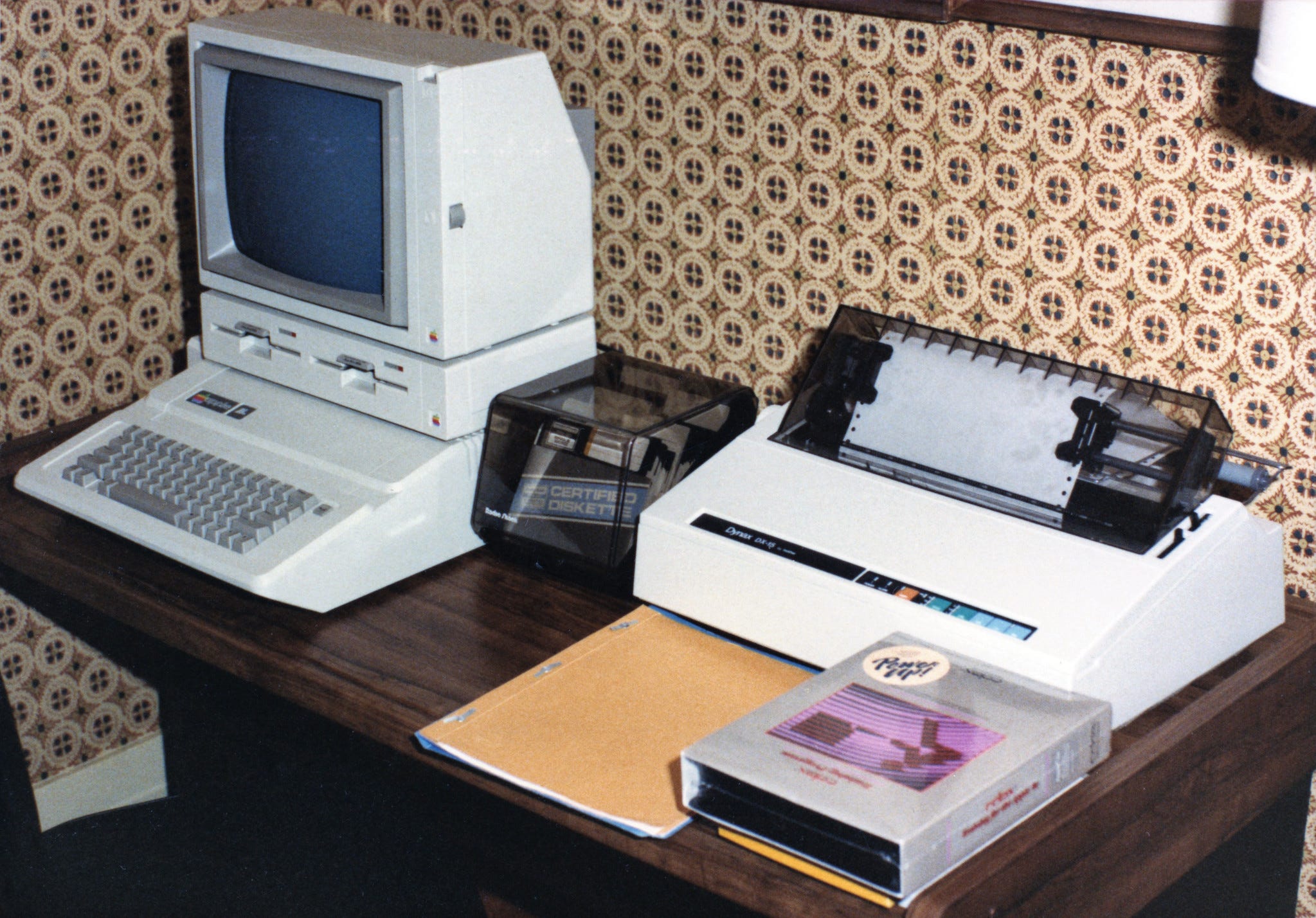
When I was in high school, personal computers were just coming on the scene. I had an English teacher who, for some reason, felt that using a computer to type your essay was cheating. If we submitted anything that looked like a printout, Mr. Harms would mark it down a full grade.
I knew how dot-matrix printers worked, so I adjusted my output settings. I chose a typewriter font and set the machine to go over each line twice, which made the letters darker and smoothed out any appearance of pixelation. Then, after printing, I carefully removed the sprocket-hole strips on either side. This left a fuzzy edge from the tiny perforations, which I removed by wetting a finger and rubbing it up and down the sides of each page until they were as smooth as a normal sheet of typewriter paper.
The result: five-paragraph essays that looked indistinguishable from anything typed on a typewriter. Mr. Harms never marked me down for using a computer, and I continued to write my essays on my trusty Apple IIe.
I don’t think my essays were materially different just because I wrote them in a word processor, although there were probably fewer typos. The English teacher’s aversion to computers was nothing more than a suspicion that his students would somehow use it to chat, or maybe just fear of the unknown. That suspicion was short lived. Within a couple of years, in college, I was submitting papers that were obviously printed out, and nobody cared. A couple of years after that and we were all using laser printers to produce beautifully designed pages with proportional fonts and embedded graphics, and far from causing suspicion, it gave rise to a whole cottage industry of desktop publishing professionals.
(Today, I have both a computer and a typewriter on my desk. I don’t use the typewriter nearly as much, but it is still a tool I love, and for some purposes, like poetry and personal letters, it is far more satisfying to use.)
I’m beginning to believe that we’re in the dot-matrix era of AI. Some of us are clearly like Mr. Harms. We find obvious AI writing offputting and obnoxious. So those who do use AI in writing are trying to hide it. They apply AI detectors and customized prompts. They remove obvious AI tells like em dashes and “It’s not X. It’s Y” constructions, in an effort to get their AI-written text to sound less like it was written by AI.
In a few years all that is probably going to seem ridiculous. I suspect no one will care about AI-generated writing, if it’s good enough.
But what does “good enough” mean when it comes to writing?
A few weekends ago, K and I went to see Supergirl in the movie theater. It was a welcome escape -- a fun, girl-powered romp through space, with satisfyingly evil bad guys and a sympathetically messed-up young woman drinking her way through an identity crisis, then solving things by recommitting to her super powers. On top of that, it’s got Jason Momoa as an immortal space biker with a bad attitude and some great lines, which he delivers in a comic growl. We ate too much buttery popcorn, drank too much Powerade, and enjoyed the movie -- most of it anyway.
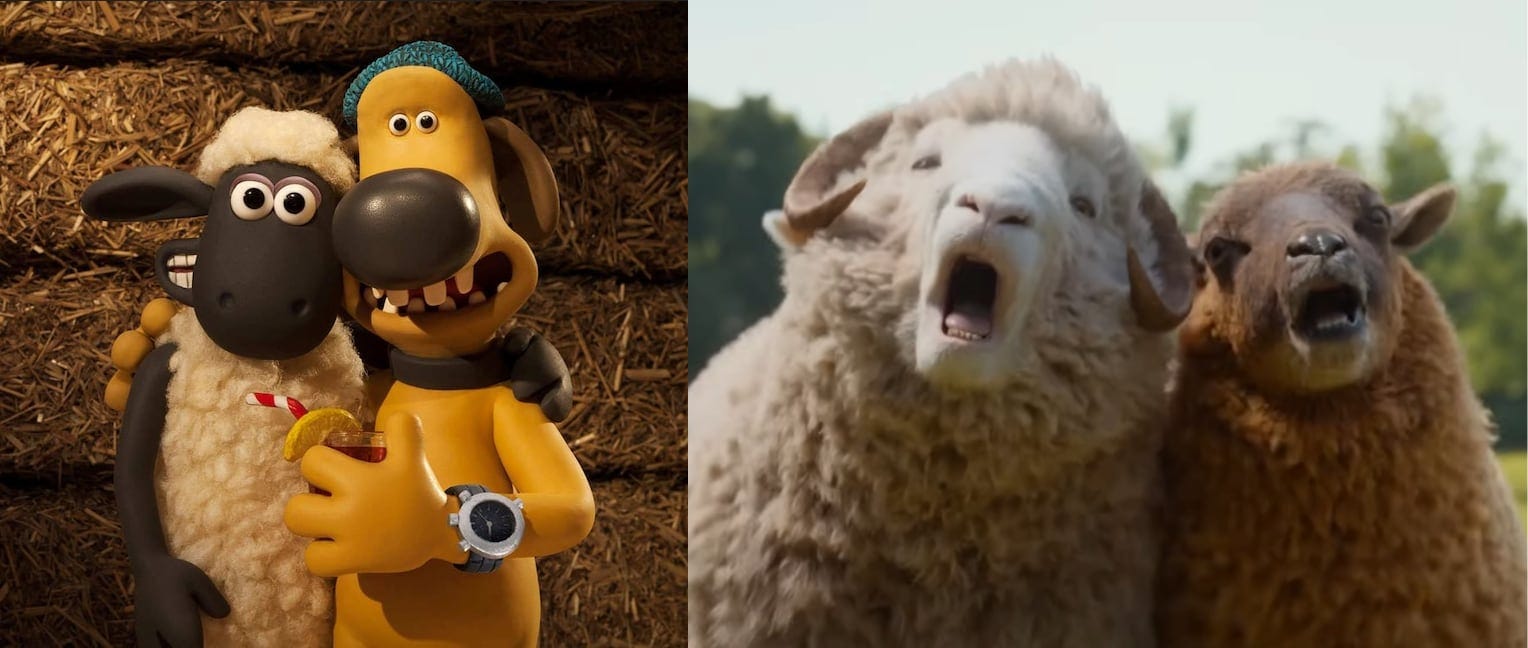
There was one exception: Krypto, the superdog, seemed thoroughly AI-generated, and for some reason that made him incredibly annoying. Sure, I expect computer graphics when a movie needs to show a dog zooming through space. And CGI or AI is not annoying when superheroes are doing their superhero things, flying around at supersonic speed, picking up tanks and smashing them, blasting things with their laser eyes, etc. But when a movie uses it for a dog that’s just sitting on the grass, something seems off about it.
I felt the same way when we tried to watch The Sheep Detectives on Amazon Prime later that weekend. Five minutes of AI sheep and I had to turn the TV off. It was just too much fakery.
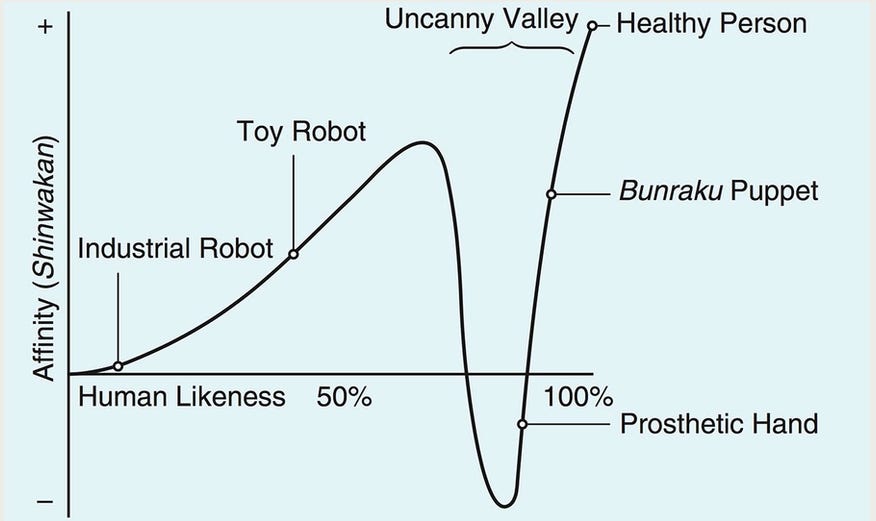
Animation researchers coined the term uncanny valley a few decades ago to describe the weird feeling you get when something appears almost, but not quite, realistic.
Animated giant fuzzy monsters? No problem. Claymation sheep? Love those guys. But as soon as the animation gets too close to something real, our critical faculties kick in. If it’s not a perfect imitation, it’s awful. The reaction: Get it away!
Something similar is happening in the world of AI content. It’s getting more ubiquitous, and at the same time it’s getting easier to detect -- especially the stuff that’s pretending to be human. Apparently 41% of the longer posts on LinkedIn are AI-generated now. (Substack’s a little better: It’s only 10% machine-made.) And I’m getting sick of it.
Never mind whether I am able to accurately assess the provenance of any given piece of content. Humans are famously bad at detecting AI-generated content in controlled experiments.
But what we are good at is detecting BS. I don’t care if you actually wrote it with your ink-stained hands in a composition book or if you had ChatGPT spit it out: If it sounds like AI content, I don’t like it.
“The problem is that the efficiency and frictionlessness that make AI appealing to writers are the same qualities that make it feel untrustworthy to readers,” Eve Fairbanks wrote in the Atlantic.
I’m not talking about using Claude or ChatGPT as a writing companion, asking it questions and working with it iteratively to produce something worth reading. I’ve found LLMs to be terrific research assistants. They’re great at boiling down data, scanning the web for ideas, distilling long texts, and helping me think through the themes and organization of something I’m writing. Claude helped me learn that it was Masahiro Mori, a robotics professor in Tokyo, who coined the term “uncanny valley” in 1970. Claude also uncovered a 2025 MIT thesis paper by Deepali Kishnani that finds the effect applies to text-only interactions as well as images, a finding that will surprise no one who has ever asked ChatGPT to correct an error in its output.
So yes, I do use AI to help me write. But asking an LLM to write the text for me doesn’t cut it.
The fact is, AI just doesn’t write very well. It might seem good enough, especially to a more careless reader reader, but there’s something off.
The result: Uncanny. Burn it with fire!
Obviously, I’m a writer and editor, and my paid work as an editorial consultant involves helping people, mostly tech execs, produce leadership writing. So I’ll admit that I have a horse in this race.
But when I talk about my work, people often ask me whether I’m worried if I will be replaced by AI.
It depends on how you understand what I do.
If my job were simply producing strings of coherent, polished-sounding text, then I’m toast. If my job is “wordsmithing” -- taking other people’s ideas and hammering their words into prettier shapes -- then likewise, my job is kaput. AI can do both of these things very well.
But the reality is that much of my work is about talking with people, listening deeply to them, helping them understand what their purpose is in writing, and then helping them find a form that expresses that.
These are journalistic skills -- storytelling skills -- interpersonal skills. This is the work of an editor and coach, and it is more valuable than ever.
That’s because AI can produce beautiful-looking copy, but it cannot supply the purpose, the connection, and the conviction that we crave as readers.
We are surrounded by junk content. All day long we see advertisements trying to grab our attention, social media posts trying to get us to engage (often through outrage), and news headlines trying to get us to click. If we use AI chatbots, we add to that flood because we are deliberately engaging in simulated conversations that tend to confirm our biases and tell us what we want to hear.
I believe that writing that can cut through all that junk will stand out. In the short term, chasing the algorithm might lead to more followers and more engagement. But in the long term, people will reward real human voices.
My dot-matrix hack worked because the teacher couldn’t tell the difference. That’s not what’s happening with most of the AI-generated junk I see on LinkedIn and in my inbox. People can tell. You’re not fooling anyone. And people care, because the AI stuff is just as repellent as an excessively realistic animated dog.
AI is not going away as a writing tool. The question is whether you can use this tool in a way that is not obnoxious. Whether you can use AI to help your writing be more human, more powerful, more persuasive — and maybe even fun to read.
So never let AI write your first draft. First write the thing that only you could have written. Put your hand back in the page.
Then try not deleting the sentence that feels like it’s revealing too much. Try leaving in the line that feels a little too unfinished. Not everything has to be perfect. In fact, it’s better if it’s not.
If you want to write well, stop trying to hide the process. Use AI, or don’t. Use a typewriter or a word processor. But put your heart into it.
Field notes
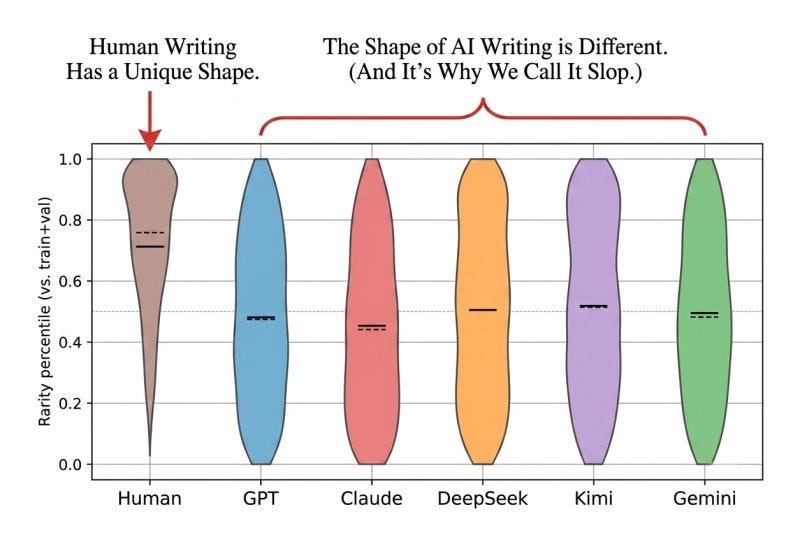
AI writing has a shape. This chart has been making the rounds; the full research paper (StoryScope: Investigating idiosyncracies in AI fiction) explains in much greater detail how AI-generated writing has distinctive “fingerprints” with respect to its narrative features. In short: “AI stories over-explain themes and favor tidy, single-track plots while human stories frame protagonist’ choices as more morally ambiguous and have increased temporal complexity (e.g., flashbacks, nonlinear structure).” via Ryan Levesque
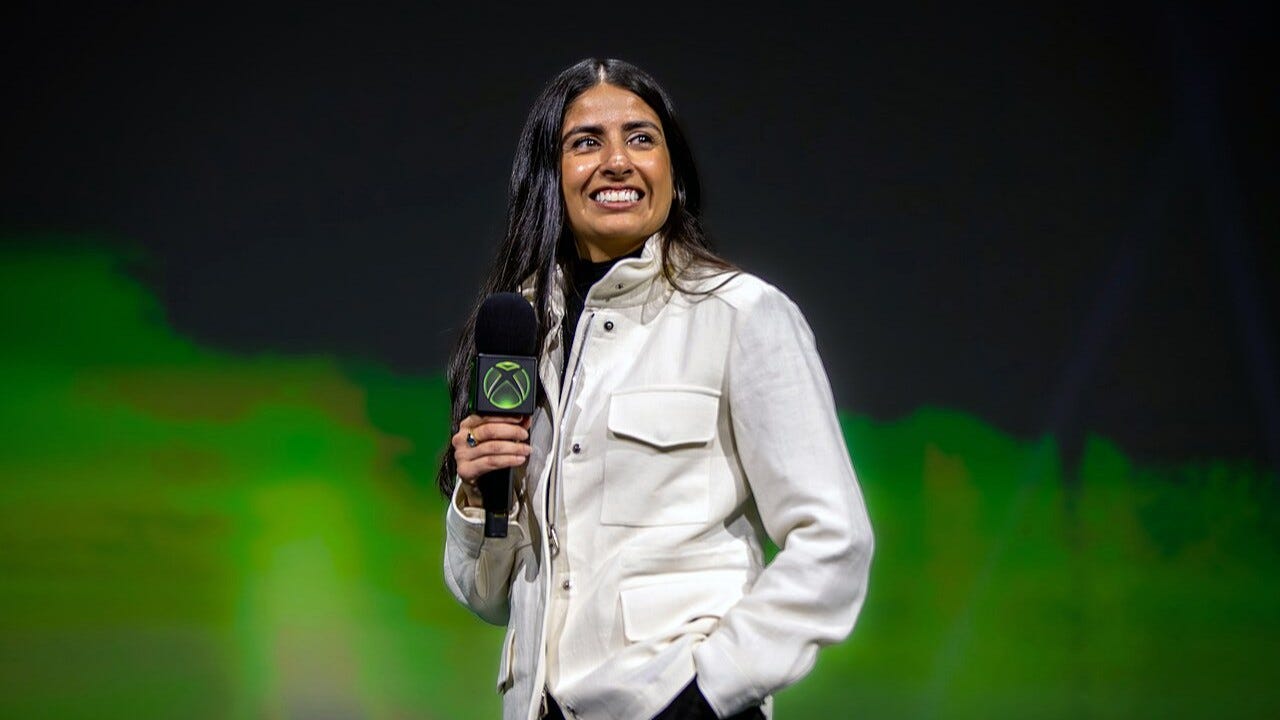
Layoff memo goes viral. Microsoft's Xbox division slashed 3,200 jobs earlier this month. While flawed, the layoff memo from Xbox CEO Asha Sharma is better than the backlash suggested -- and it was fixable. My analysis generated a lot of reaction: What Xbox CEO Asha Sharma got right about her layoff memo -- and what she got wrong
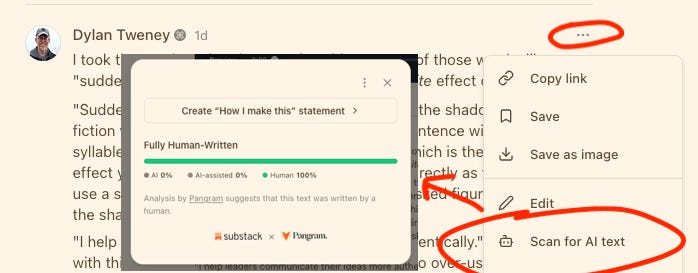
Substack BS detector. Substack has partnered with Pangram — the makers of an AI-detection plugin and the source of that figure I mentioned above about 41% of LinkedIn posts being AI-generated — to flag the AI-generation status of any post on the Substack platform. I’m looking forward to seeing this. LinkedIn needs one too. News coverage on TechCrunch. I tested it on my latest Substack post. Verdict: 100% human.
Also 100% real. My dog Lucy, still the best at being totally relaxed.